
Feeling Lost in Building Rapport with International Managers and Colleagues? Have not gotten an answer? Don’t worry. You are not alone.
The leadership style around the world
I started working in 2012 and only worked with a Vietnamese manager for less than a year. From then on, I have been working with multiple managers coming from different culture background: Japan, Singapore, Russia, Croatia, Germany, France, US etc. As much as I admired them about their work ethics, as challenging as it could be for me to understand the way how they made decisions. I believe, understanding different leadership styles around the world is crucial for any employees working with foreign managers, as it sheds light on the rationale behind diverse managerial approaches and practices.
I stumbled on this following diagram when I read up about leadership styles. It illustrates various leadership styles prevalent in different cultures, providing insights into how leadership is perceived and enacted globally. For instance, a manager from an Asian collectivist culture might emphasize group harmony and consensus, while a leader from an individualistic society might prioritize personal initiative and autonomy (US). By familiarizing ourselves with these differences, we can better understand their manager’s expectations and methods, fostering a more cohesive and productive working environment.
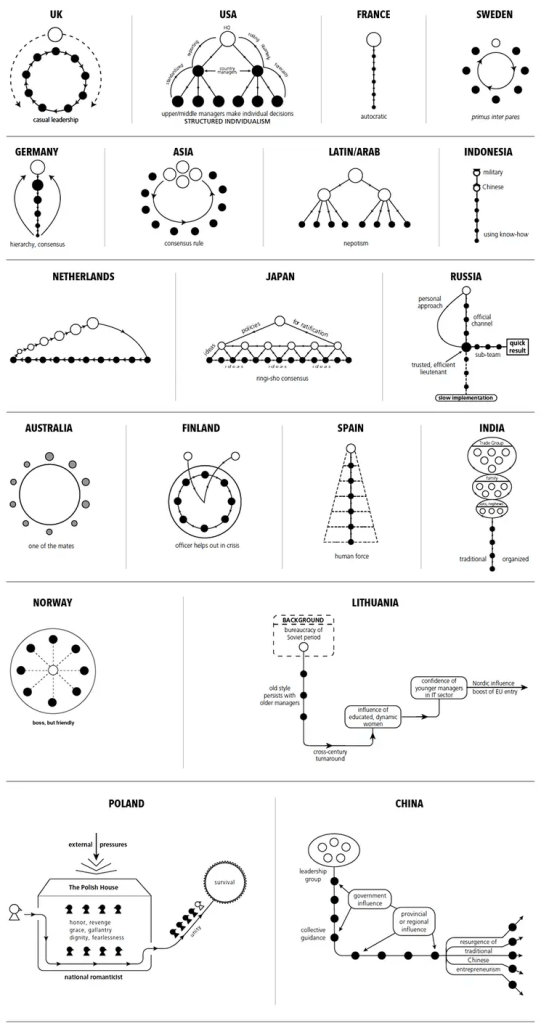
Image credit: When Cultures Collide by Richard Lewis https://amzn.eu/d/7NmODJN
The culture map – A framework to resonate with your colleagues
In meetings with Vietnamese stakeholders, I often encounter subtle push-back or indirect negative feedback, requiring me to read between the lines to understand the true sentiment behind phrases like “It’s a good work.” While this can boost one’s ego in a large meeting, it often delays achieving the right outcomes. In contrast, my German colleagues are straightforward and openly critique my deliverables, suggesting areas for improvement. Initially, this directness was challenging, making me feel undervalued. However, over time, I realized that this frank feedback significantly improved my performance and project outcomes.
I wish I had known about “The Culture Map” earlier. In a world where remote work is becoming the norm, understanding cultural differences through this tool can help reduce workplace conflicts and misunderstandings.
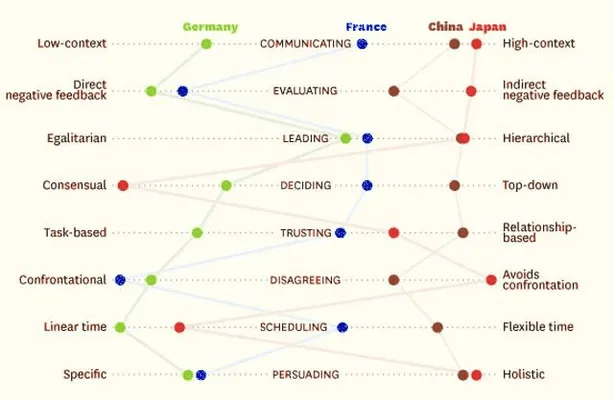
This framework developed by Erin Meyer, is an invaluable tool for employees seeking to understand and collaborate effectively with colleagues from diverse cultural backgrounds. This model highlights eight dimensions of culture, such as communication, evaluation, persuasion, leading, decision-making, trust, disagreement, and scheduling.
By examining these dimensions, employees can gain insights into the implicit cultural norms and practices that influence workplace behaviors and interactions. For example, understanding whether a culture favors high-context communication, which relies heavily on non-verbal cues and context, versus low-context communication, which is more explicit and direct, can help in crafting clearer and more effective messages. Similarly, recognizing different approaches to leadership and decision-making can bridge gaps in expectations and foster mutual respect.
 hello.thuydo